
Table of Contents
Origin of Mastiff
Mastiffs existed a long time ago and often referred to as dog-like beasts. They were better known as Molossus and eventually just dogs. These dogs can be seen in the ancient images relating to Babylonian relics way back in 2200 BC. During these times, the dogs we commonly used during wars. There are drawings dating back to 650 BC which featured mastiff-like dogs sculptured in Assyria. It is not known how these giant canines were bred, or if they evolved and matured on their own. The Romans transported them to Rome for entertainment purposes, by using them in organized fights with bears and lions in pack.
All large dog breeds were referred to as Mastiffs, which is a term derived from ‘Mastin’ in French language, meaning a watchdog. They were also commonly used as guardians for livestock and homes, particularly protecting them from bears and various other wildlife that roamed freely in the forests and wilderness back then.
It is, however, well-established that mastiff’s ancestors arrived in Britain from Central-Asia, and the Phoenician traders were responsible for it, way back in 500 BC or over 2000 years ago. The British were in awe of this breed simple due to their massive size and powerful display of strength. It is for these reasons that the mastiffs got commonly engaged in organized fights with animals, including other dogs and bears, in medieval England in 1500/1600s.
During the 1800s, they were primarily used for guarding and as companions, given their loyal and courageous behavior towards their owners. They could be spotted on large properties and were renowned for their gentle and composed temperament.
One of the most authoritative texts written on Mastiff history is called ‘The History of the Mastiff by M.B. Wynn, which first got published in 1886, and till date, is one of the most authoritative works on this enigmatic dog breed.
From Ancient Times to the Early Nineteenth Century
The ancestors of modern Mastiffs can be traced back to those large dogs shown as figurines and in bas-reliefs from 6th century BC in Assyria, during the reign of King Ashurbanipal. There is, however, no genetic evidence or established historical link to affirm this, and it is mere speculation. A similar figurine from same region during the Kassite period is also traced as mastiff’s ancestors, which was over a thousand years earlier. The presumption is that mastiffs may be related to the dogs that combated with lions, tigers, bears, and gladiators in arenas in ancient Rome.
The Pugnaces Britanniae that was in existence during the conquest of Britain by Rome is meant to have a confirmed trace in the formation of English Mastiff.
The Greek historian Strabo had reported about the export of dogs from Britain for game hunting, and used often by the Celts during wars. The Pugnaces Britanniae is meant to have descended from dogs that the British brought by the Phoenicians during the 6th century BC. Caesar also wrote about them in England during 55 BC during his invasions. A lot of these dogs were sent to Italy and during Roman Empire they assumed the role of fighting dogs and with AKC recognition happening in 1885.
The Alaunt is likely to have been another genetic predecessor to the English Mastiff. Introduced by the Normans, these dogs were developed by the Alans, who had migrated into France (then known as Gaul) due to pressure by the Huns at the start of the fifth century. Intriguingly they were known from the Romans to live in a region (the Pontic-Caspian Steppe) about 700 km to the north of the region where the Assyrians once lived. Again, any canine connections are speculative.
The term “Mastiff” has an unclear origin and is meant to have evolved from Anglo-Saxon term “masty”, which means “powerful”. Oxford English Dictionary proclaims it derived from the French term “Mastin’. The very first compilation of dog breed names in English were found in The Book of Saint Albans, which was attributed to Prioress Juliana Berners, published in 1465, and includes a reference to “Mastiff “.
In 1570, Conrad Heresbach, in his Latin work called Rei Rusticae Libri Quatuor, referred to “the Mastie that keepeth the house”. This writing was then later translated after a few years into English by Barnabe Googe and that work was know as Foure Bookes of Husbandrie. These texts from the Roman to Medieval times capture the fact that Mastiff-like dogs were commonly used for blood sports that included bear-baiting, bull-baiting, lion-baiting, and dog fighting, and also for hunting and guarding properties and persons.
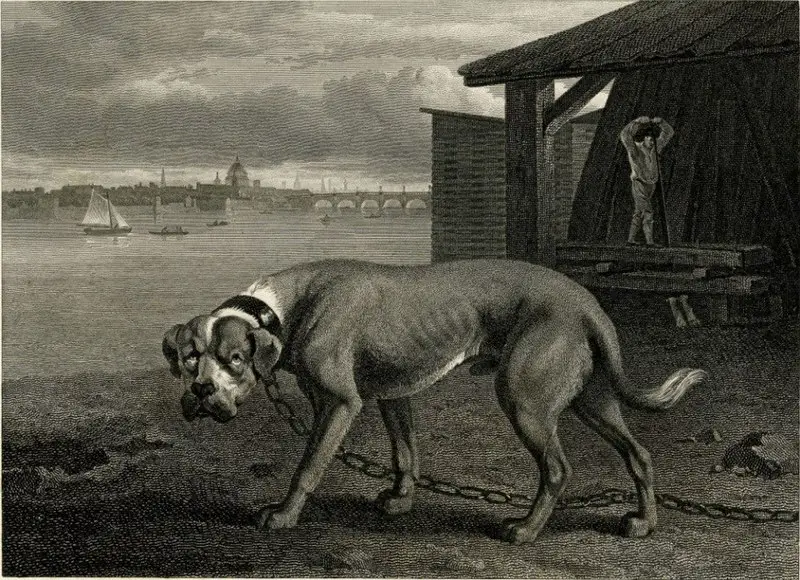
Then there were dogs which were referred to as Bandogs that used to be tied and hence bound close to people’s properties, and these were also of Mastiff types. In 1570, these dogs were described by John Caius as “vast, huge, stubborn, ugly, and eager, of a heavy and burdensome body”.
In 1666, Christopher Merret, who was a naturalist, wrote in his work called Pinax Rerum Naturalium Brittanicarum regarding a list of British canines that had 15 types of dogs, including a “Molossus, Canis bellicosus Anglicus, a Mastif”. This was probably the first interchangeable use of the dog breeds Molossus and Mastiff.
Sir Peers Legh, in 1415, got wounded in the Battle of Agincourt. During this battle, his Mastiff stood the ground bravely and protected him for several hours whilst the battle was ongoing. He was later sent back to Legh’s home and became the foundation of Lyme Hall Mastiffs. 500 years later, this pedigree played a vital role in the evolution of what is now the modern breed. Some of the other well known aristocratic seats where Mastiffs were kept are Elvaston Castle (Charles Stanhope, 4th Earl of Harrington and his ancestors) and Chatsworth House.
Mastiffs have also featured at Hadzor Hall, which was owned by members of the Galton family, as well as renowned industrialists and scientists, such as Charles Darwin. There is also evidence to suggest that Mastiffs first came to USA on the Mayflower, however, their subsequent documented entry to USA suggest that they did not arrive in the country until the late 19th century.
Roman Mastiff War Dog
Dogs have an established history of being used in warfare, starting during the ancient times. They have adopted and evolved in various roles such as combat trained, scouts service providers, sentries and trackers. They have fulfilled multiple roles and still continue to play a key role in modern military usage.
The Romans particularly found the mastiff to be very intriguing, and during their most powerful times during the Roman Empire, they afforded the mastiff with a lot of respect primarily due to its role as a war-dog and fighting dog.
When the Romans occupied Britain (55 BC – 415 AD), they also exported lots of dogs from there to Rome. These dogs were left to fight for themselves and their meals during their long and multiple expeditions. There was no animal cruelty or safety laws back then. In fact, it was quite the opposite, as the dogs were left to fight the lions in arenas for pleasure and entertainment. Regardless, the Romans have always glorified the mastiffs in their history records. Some of the roman officers also honored themselves by owning mastiffs. They used to train them for war purposes and for their personal protection. This beast of a dog weighing 100+ kgs with the right training and an aggressive and ferocious temperament would prove to be violent and much feared canine to tackle. Mastiffs have also sacrificed their lives for their masters in a military battle and thereafter, became heroes for life. Cesar’s favorite dog was reportedly a mastiff as well.
The Molossus (as it was known in Rome) was renowned all over the ancient world for its size and ferociousness. The ancient literature by renowned writers such as Aristophanes, Aristotle, Grattius, Horace, Lucan, Lucretius, Martial, Nemesianus, Oppian of Apamea, Plautus, Seneca, Statius, Suda and Virgil have all mentioned about mastiffs in one context or the other. The Molossians even issued a silver coinage that carried an image of a Molossus as part of their emblem.
Molossians kept two distinct types of dogs a hunting dog with a wide muzzle which is commonly quoted as the ancestor to the modern type of mastiff, and the second was a large guardian dog to protect livestock.
Aristotle in his History of Animals wrote that mixed breed dogs that are produced by a Molossian and the Laconian, stand out for their courage, resilience or hard labor.
History of the Standard
The breeding standards of a mastiff were first published in 1859 by ‘Stonehenge’ (Dr John Henry Walsh) in ‘The Dog in Health & Disease’ which provided certain points of the Mastiff vis-à-vis its body parts, colors, character and symmetry.
The mastiff was referred to or defined as follows: “A head of large size between that of the bloodhound and bulldog in shape having the volume of muscle of the latter, with the flews and muzzle of the former…”.
In 1890, mastiff points were given a numerical value (as detailed below) and that became the revised standard until after the Second World War, after which, the system was eradicated for all dog breeds.
- Muzzle – 18 points
- Skull – 12 points
- Height and substance – 10 points
- Forelegs and feet – 10 points
- Character and symmetry – 10 points
- Hind legs and feet – 10 points
- Chest and ribs – 8 points
- Back, loins and flank – 8 points
- Eyes – 6 points
- Color – 5 points
- Ears – 4 points
- Tail – 3 points
In 1949, all the standards were taken over by The Kennel Club, adding a gait/movement clause.
Last update on the standards was reported in 2009.
The Mastiff Breed in the First World War
Mastiffs started disappearing in the US on a steady basis through the 1890s and early 20th century. From 1906 to 1918, there were surprisingly only 24 Mastiffs left in the USA. After 1910, these weren’t bred in USA and by the time the First World War came to an end, this breed was practically extinct outside of the Britain, minus some exports into North America.
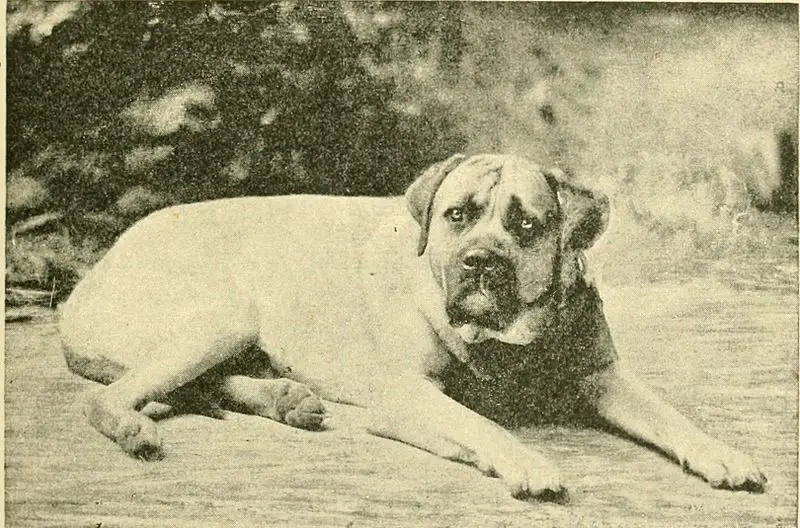
In 1918, a dog named Beowulf was bred in Canada that was obtained from British imports and got registered by the American Kennel Club. This kick-started a slow re-start of breeding breed mastiffs in North America once again. Some of the people who contributed to the breeding process included Priam and Duchess, Ch Weland, Thor of the Isles, Caractacus of Hellingly and Brutus of Saxondale.
